Manufacturing Software Solutions

Software Built Around How Manufacturing Actually Works

Improve production, inventory, scheduling, shop-floor data collection, reporting, and system integration without forcing your operation into software that does not fit.

Common Manufacturing Challenges

When the Software Becomes Part of the Bottleneck

Manufacturing systems often evolve one workaround at a time. Eventually, people spend too much time moving information instead of moving production.

Production Keeps Changing

Schedules live in spreadsheets, priorities shift, and everyone is working from a different version of the plan.

Inventory Is Hard to Trust

Raw material, WIP, remnants, and finished goods are difficult to locate or reconcile.

Systems Don't Talk

ERP, MES, machines, databases, spreadsheets, and custom tools require manual handoffs.

Shop-Floor Data Arrives Late

Production, quality, downtime, and material information may not be visible until after decisions need to be made.

Manufacturing Capabilities

Software Across the Operation

We build new systems, improve existing ones, and connect the tools you already rely on. The best solution is the one that removes friction from the operation.

Production Scheduling & Workflow

Give planners, supervisors, and operators a clearer view of what needs to happen next and what is getting in the way.

  • Production scheduling
  • Job and work-order tracking
  • Routing and sequencing
  • Capacity and constraint visibility
  • Paperless workflows

Inventory, WIP & Material Tracking

Improve confidence in what you have, where it is, and what is available for production.

  • Raw material and finished goods
  • Work-in-process tracking
  • Lot and serial traceability
  • Multi-location inventory
  • BOMs, reorder alerts, scrap and remnants

ERP, MES & System Integration

Extend the systems you already own instead of automatically replacing them.

  • ERP and MES integration
  • Order-entry and production systems
  • Database and API integration
  • File-based and middleware integrations
  • Legacy application connectivity

HMIs & Shop-Floor Applications

Build interfaces for the realities of production, not for someone sitting at a desk.

  • Human Machine Interfaces
  • Touchscreen operator applications
  • Work instructions and job information
  • Production and quality entry
  • Multilingual and accessible interfaces

Barcoding & Data Collection

Make data capture faster and more reliable at receiving, production, inventory, quality, and shipping.

  • 1D and 2D barcodes
  • QR codes
  • Handheld and fixed scanners
  • Mobile and tablet scanning
  • RFID where it is the right fit

Reporting & Operational Visibility

Bring together production, inventory, scheduling, quality, and machine data so people can act sooner.

  • Production dashboards
  • KPI and management reporting
  • WIP and backlog visibility
  • Automated reports and alerts
  • Cross-system reporting
Explore Reporting & Dashboards →

Quality & Traceability

Capture the production history needed to understand what happened, when it happened, and what was affected.

  • Inspection and quality data
  • Lot and serial history
  • Production genealogy
  • Measurement-system integration
  • Exception and nonconformance tracking

Machine & Equipment Integration

Move useful information between machines, operators, and business systems—even when the equipment is older.

  • Machine data collection
  • CNC and proprietary equipment
  • Serial and custom communications
  • PLC communications when needed
  • Legacy equipment integration

Material Optimization & Scrap Reduction

Use software to improve yield, reduce waste, and make better use of expensive raw material.

  • 1D and 2D cutting optimization
  • Nesting and stock utilization
  • Scrap and remnant management
  • Production sequencing
  • Machine movement optimization
Explore Material Optimization →
A Manufacturing Difference

We Understand the Space Between the Shop Floor and the Business Office

Many software firms are comfortable with databases, web applications, and cloud systems. Many industrial firms are comfortable with machines and controls. Manufacturing projects frequently need someone who can work between those worlds.

Our role is often to help information move from equipment and operators into the systems that planning, quality, inventory, customer service, and management rely on—and back again.

See Manufacturing Projects
30+
years solving business and manufacturing software problems
Production • Inventory • Scheduling • HMIs • ERP/MES • Barcodes • Reporting • Optimization • Legacy Systems
Connected Manufacturing

Connecting the Business Systems and the Shop Floor

Manufacturing information needs to move in both directions. Orders, schedules, recipes, specifications, and priorities often flow from business systems to the shop floor, while production status, material usage, quality data, measurements, and machine activity flow back. Tornado can help anywhere along that path.

Business Systems & Teams

The systems and people planning, managing, and supporting the operation.

ERP MES Inventory Scheduling Quality Dashboards
↔

Manufacturing Software & Integration

Applications and integrations that connect processes, systems, operators, and equipment across the operation.

Custom Apps APIs Databases Middleware Workflow Legacy Systems
↔

Shop Floor & Equipment

The applications, operators, scanners, machines, and devices involved in production.

HMIs Scanners CNC Sensors PLCs Legacy Equipment
Tornado can help in any of these areas. Sometimes the need is a new production application. Sometimes it is improving an ERP workflow, modernizing a legacy system, building an HMI, collecting shop-floor data, or connecting systems that were never designed to work together.
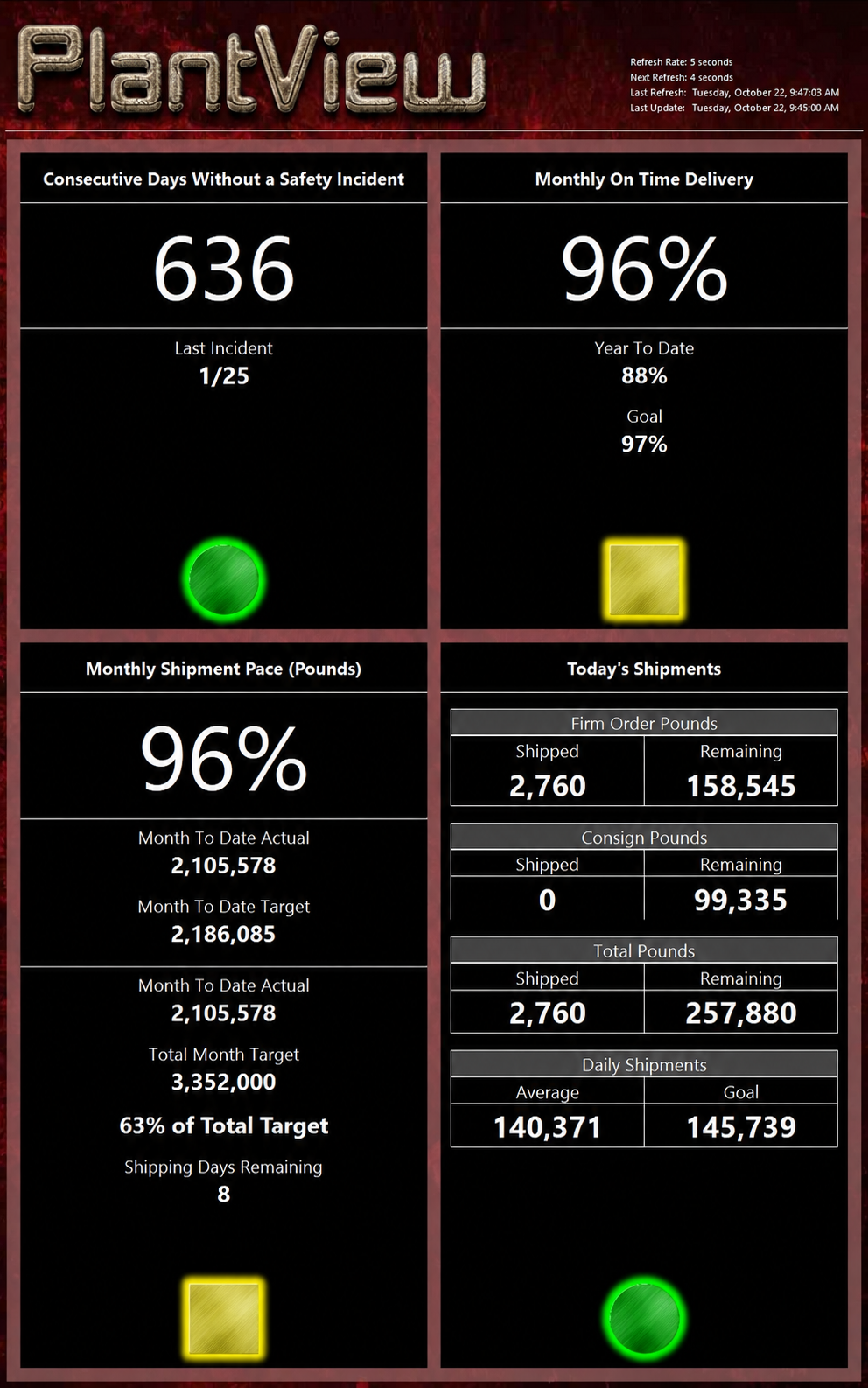
PlantView manufacturing dashboard showing production activity and equipment status
Manufacturing Application Example

See What’s Happening Across the Plant Floor

A custom manufacturing dashboard gives teams a clear view of production activity, equipment status, and the information they need to make faster day-to-day decisions.

Explore more projects →

Featured Expertise

Material Optimization & Scrap Reduction

When material is expensive and production volume is high, even a small improvement in yield can produce meaningful savings. We have built one-dimensional and two-dimensional optimization systems for cutting, nesting, sequencing, and scrap reduction.

Explore Material Optimization
Client Perspective

What a Manufacturing Client Says

“I’ve had the privilege of working with Mark and Tornado Technologies for more than 30 years. Throughout that time, he and his team have developed complex material optimization algorithms and delivered solutions that drive automated machinery and sophisticated scheduling systems. Mark is not only the company’s owner; he is also an exceptionally skilled programmer in his own right. Two qualities have always stood out to me. First, Mark and his team understand their audience and communicate complex concepts in a way that everyone can understand. Second, their decades of manufacturing experience enable them to make thoughtful recommendations that save clients valuable development time and ultimately result in more robust, reliable products.”

— Scott, Software Sales Application Specialist, Industrial Equipment Manufacturer
Examples of What This Looks Like

Manufacturing Software Projects

The point is not the technology. It is solving the operational problem in a way that fits the people, equipment, and systems already in place.

Scheduling

Production Scheduling System

Improved workflow visibility and helped coordinate changing priorities across production.

Inventory

Inventory & Material Tracking

Tracked inventory, work orders, material usage, and operational status more accurately.

Shop Floor

Operator HMI Application

Created a production-facing interface that simplified operator interaction with equipment and data.

Barcoding

Barcode Data Collection

Reduced manual entry by capturing inventory or production events directly at the point of work.

Integration

ERP / Production Integration

Moved information between business systems and custom production applications without duplicate entry.

Optimization

Material Yield Improvement

Used custom optimization logic to reduce material waste while protecting production throughput.

Quality

Measurement & Quality System

Captured and organized manufacturing measurements for faster access and better traceability.

Visibility

Manufacturing Dashboard

Combined operational data into a clearer view of production, inventory, and performance.

Reporting & Dashboards

Turn Manufacturing Data Into Decisions

Production dashboards belong in manufacturing, but reporting is a broader capability. Our dedicated Reporting & Dashboards solution covers KPI dashboards, cross-system reporting, automated reports, and other ways to make operational data more useful.

Explore Reporting & Dashboards

FAQ

Common
Questions

Manufacturing software comes in many forms, but most projects are designed to solve one of four challenges: improving visibility, increasing efficiency, reducing waste, or integrating systems that don’t currently work well together.

Over the years, we’ve developed a wide range of manufacturing solutions, including:

  • Production Scheduling Systems

  • Material Optimization, Yield Improvement, and Scrap Reduction Systems

  • Machine Integration and Data Collection Systems

  • Inventory and Warehouse Management Systems

  • Production Tracking and WIP Dashboards

  • Machine HMIs and Touchscreen Interfaces

  • Production Dashboards and KPI Reporting

  • ERP and Business Management Applications

  • Quality Control and Traceability Systems

  • Barcode, QR Code, and RFID Solutions

  • Workflow Automation and Paperless Manufacturing Systems

  • Vision Systems and Image Processing Applications

We’ve also developed software that communicates with manufacturing equipment using technologies such as APIs, serial communications, file transfers, middleware, PLCs, and proprietary protocols. In some cases, we’ve even reverse-engineered undocumented communication methods to help older equipment communicate with modern business systems.

One area where we have particularly deep experience is optimization. We’ve developed applications that optimize material utilization, reduce scrap, improve production sequencing, and even minimize cutting-head travel time. The results can be significant—in some cases clients have recovered the entire cost of an optimization project in less than six months through material savings alone.

Our experience includes projects in industries such as fenestration (window and door manufacturing), industrial manufacturing, fabrication, material processing, warehousing, and distribution. We’ve worked with manufacturers ranging from highly automated production environments to organizations that still rely heavily on manual processes, spreadsheets, and paper-based workflows. While every manufacturing operation is unique, many of the underlying software challenges are surprisingly similar.

The goal is not simply to build software. The goal is to help manufacturers improve efficiency, increase visibility, reduce waste, and make better operational decisions using technology that fits the way their business actually operates.

Industry experience can certainly be helpful, but it is usually not the most important factor in a successful project.

Many manufacturers initially ask whether we’ve worked in their exact industry before. We’ve heard variations of this question from companies that manufacture windows, doors, fabricated metal products, industrial equipment, specialty materials, and many other products.

While every manufacturing environment has unique terminology, processes, and requirements, the underlying software challenges are often surprisingly similar. Most manufacturers need some combination of scheduling, inventory management, machine integration, quality control, material tracking, reporting, optimization, workflow automation, and operational visibility.

Our approach is to learn your business, understand your processes, and work closely with the people who operate the system every day. We believe understanding why the software needs to work a certain way is just as important as understanding the technology itself.

Over the years, we’ve worked with a wide variety of manufacturing operations and have found that experience solving complex manufacturing problems often transfers remarkably well from one industry to another. For example, the principles behind material optimization, production scheduling, workflow automation, machine integration, and quality tracking are often applicable across many different manufacturing environments.

We’ve also learned that the people who know the business best are usually the employees, supervisors, engineers, and managers who work with the processes every day. Successful projects combine their industry expertise with our software and manufacturing systems experience.

The goal is not to become experts in your product. The goal is to become experts in the software challenges that are preventing your operation from running as efficiently as it could.

Connecting machines, equipment, and business systems is one of the most common challenges manufacturers face. Production equipment, ERP systems, inventory systems, quality systems, spreadsheets, databases, and custom applications often operate independently, forcing employees to manually transfer information between them.

Over the years we have helped manufacturers connect a wide variety of systems including production equipment, ERP systems, inventory systems, quality systems, warehouse systems, custom applications, databases, dashboards, and reporting platforms.

Depending on the situation, integrations may involve APIs, databases, file transfers, serial communications, barcode systems, RFID technologies, middleware, machine-specific communication protocols, touchscreen HMIs, PLC communications, or custom-developed solutions. In some cases we have even reverse-engineered undocumented or proprietary communications when no official integration method existed.

We have connected systems using modern APIs, database connections, industrial protocols, PLCs, IoT sensors, and microcontrollers like Raspberry Pi and Arduino. If it lives on a manufacturing floor and needs to share data, we have probably connected something like it before.

Many software companies focus primarily on business applications and cloud systems. Many engineering firms focus primarily on machines and equipment. Our experience often allows us to bridge the gap between the manufacturing floor and the business systems that support it, which means we are comfortable on both sides of that boundary in a way that most vendors are not.

One thing we have learned is that successful integration projects are rarely about the technology alone. The real goal is ensuring that information moves efficiently through the organization without requiring unnecessary manual effort, duplicate data entry, or disconnected processes.

Successful integration projects are ultimately measured by how effectively information moves through the organization. When the right information reaches the right people at the right time, manufacturers can make better decisions, reduce delays, and operate more efficiently.

Many manufacturers are surprised to learn how much useful information can be collected from older equipment.

Many manufacturers rely on equipment that was built long before modern networking and Industrial IoT technologies became common. While newer machines may provide built-in communication capabilities, older equipment often requires a different approach.

We’ve helped organizations capture production counts, cycle times, quality measurements, downtime information, operator activity, maintenance data, and other operational metrics from machines that were never originally designed for modern reporting systems.

The value of this information extends far beyond reporting. Manufacturers use machine data to improve scheduling, identify bottlenecks, monitor productivity, support preventive maintenance efforts, improve quality, and provide real-time visibility into shop floor operations.

In some situations, data can be collected directly from equipment. In others, the best solution may involve operator interfaces, custom HMIs, barcode systems, touchscreen applications, or other methods that help bridge the gap between the manufacturing floor and business systems.

One common misconception is that older equipment must be replaced before meaningful data can be collected. While there are certainly situations where replacement makes sense, we’ve found that many older machines can continue providing valuable operational data with the right software solution.

The most valuable machine data is not necessarily the most complicated data. It’s the information that helps your team improve productivity, identify problems sooner, and make better operational decisions while extending the value of the equipment you already own.

For many manufacturers, material costs represent one of the largest opportunities for improving profitability. Even small improvements in yield can generate significant savings when multiplied across thousands of parts, assemblies, or production runs.

Over the years, we’ve developed software solutions that help manufacturers reduce scrap, improve material utilization, optimize production processes, and maximize yield from raw materials. Depending on the application, this may involve determining the best way to cut materials, optimizing production sequences, improving workflow decisions, reducing waste, or identifying inefficiencies that are difficult to see manually.

Our experience includes both one-dimensional and two-dimensional optimization problems. We’ve developed systems that optimize the use of materials such as metal, vinyl, glass, and other stock materials where maximizing yield has a direct impact on profitability. We’ve also developed solutions that optimize cutting sequences and machine movement to reduce production time and improve throughput.

In one project, a manufacturer provided all of the material requirements for an entire production shift. The software determined the most efficient way to utilize the available stock material, significantly reducing waste. The resulting material savings were so substantial that the client recovered the entire cost of the project in less than six months.

Optimization is not limited to material usage. Similar techniques can be applied to production scheduling, routing, workflow sequencing, machine utilization, inventory management, and other operational challenges where small improvements can create meaningful business value.

Many manufacturers assume that waste, scrap, or inefficiencies are simply part of doing business. In reality, software can often uncover opportunities that would be difficult or impossible to identify manually.

The goal is not simply to build an optimization engine. The goal is to help manufacturers reduce waste, improve efficiency, and increase profitability through better operational decisions.

Many manufacturers assume they have only two choices: continue living with the limitations of their current systems or replace them entirely.

In reality, there is often a third option: enhancing the systems you already have with targeted software improvements, integrations, automation, reporting, and workflow enhancements.

We’ve worked with organizations that believed they needed a completely new application when their real challenges were much narrower. In some cases, better reporting, improved visibility, workflow automation, machine integration, or additional functionality solved the underlying business problem without requiring a full system replacement.

For example, one manufacturing company approached us with plans to eventually replace an aging application. Initially, our role was simply to keep the existing software running until the replacement system was ready. As we learned the software, fixed issues, and added improvements, the company realized the existing application was meeting their needs far better than they had expected. Years later, they continue to use and enhance that system rather than replacing it.

We’ve also worked with companies that thought they needed an entirely new application when a reporting solution, dashboard, integration, or process improvement could deliver most of the desired benefits at a fraction of the cost.

This doesn’t mean replacement is never the right answer. Sometimes an ERP system, production system, or custom application has reached a point where modernization or replacement makes sense. However, we believe that decision should come after understanding the business requirements, evaluating the existing systems, and exploring practical alternatives.

Many manufacturers have invested years of effort into refining their processes and business rules within their current systems. Often, there is significant value in building upon that investment rather than starting over.

The goal is not to replace software simply because it is old. The goal is to identify the most practical and cost-effective way to improve the operation, whether that involves enhancing an existing system, adding complementary solutions, or pursuing a replacement when it is truly justified.

Manufacturing inefficiencies often develop gradually over time. Employees create workarounds, information gets entered into multiple systems, spreadsheets are introduced to fill gaps, paper forms continue long after better alternatives exist, and valuable time is spent moving information from one place to another.

These inefficiencies may seem small individually, but collectively they can impact productivity, visibility, quality, and profitability throughout the operation.

We’ve helped manufacturers eliminate bottlenecks by automating workflows, integrating disconnected systems, improving information flow, reducing duplicate data entry, enhancing reporting, streamlining quality processes, and providing better visibility into production activities.

Depending on the situation, solutions may involve barcode scanning, QR codes, RFID technologies, touchscreen interfaces, electronic forms, automated workflows, machine integration, photo capture, mobile devices, dashboards, or custom manufacturing applications.

For example, instead of manually recording production activity and later entering the information into another system, operators may be able to scan a barcode, enter information through a touchscreen interface, or have data collected automatically as part of the production process. Information can then become immediately available to supervisors, planners, quality personnel, and management without requiring duplicate entry.

We’ve also found that many bottlenecks are caused by information delays rather than production limitations. When people have timely access to accurate information, they can often make better decisions, respond more quickly to problems, and keep work moving through the operation more efficiently.

Many manufacturers still rely on spreadsheets, paper forms, and manual processes because that’s how the operation evolved over time. Often, significant improvements can be achieved without replacing the systems that people already use every day.

The goal is not simply to automate a process. The goal is to remove friction, improve information flow, and help the entire operation run more efficiently.

One of the biggest challenges in manufacturing is turning operational data into information that people can actually use. Many organizations have access to large amounts of data, but struggle to see what is happening across the operation in real time.

We’ve developed a wide variety of dashboards and reporting systems that provide visibility into production, inventory, quality, scheduling, material utilization, work-in-process (WIP), machine activity, safety metrics, and other key operational indicators.

Depending on the needs of the organization, dashboards may display information from ERP systems, production equipment, inventory systems, quality systems, spreadsheets, custom applications, or multiple systems simultaneously. In many cases, bringing information together into a single view is just as valuable as the dashboard itself.

We’ve also found that the most effective dashboards are designed around decisions rather than data. A production supervisor may need to see bottlenecks, downtime, and production progress. Management may need KPIs, trends, and operational metrics. Operators may need real-time production information and work instructions. Different users often require different views of the same information.

In addition to dashboards, we’ve developed automated reports, KPI scorecards, production summaries, WIP tracking systems, and operational reporting tools that help manufacturers monitor performance and identify opportunities for improvement.

The value of a dashboard is not measured by how much data it displays. The value comes from helping people recognize problems sooner, make better decisions, and improve the performance of the operation.

The best dashboards help people take action. When the right information is presented to the right people at the right time, problems become easier to identify, decisions become easier to make, and operations become easier to improve.

Many manufacturers assume their equipment, processes, or requirements are too specialized for an outside software company to understand. In reality, some of our most successful projects have involved highly specialized equipment, unique workflows, and challenging technical requirements.

Over the years we have worked with CNC equipment, machine HMIs, vision systems, laser measurement systems, quality control systems, chemical analysis applications, proprietary manufacturing equipment, and custom production environments. We have also worked with equipment that communicated using undocumented or proprietary methods when standard integration approaches were not available.

In one project we developed software used in conjunction with laser measurement systems that verified parts manufactured to extremely tight tolerances for military aircraft applications. In another we worked with systems used for chemical analysis where data accuracy and reliability were critical to the operation.

We also recognize that manufacturing environments are different from office environments. Operators may be wearing gloves, working in noisy conditions, or interacting with equipment under time-sensitive production demands. User interfaces for the shop floor need to reflect those realities, with large buttons, clear information, and intuitive workflows that work under production pressure, not just in a comfortable office setting.

We have also built multilingual applications for manufacturers whose workforce speaks more than one language, and we have experience designing interfaces that meet ADA accessibility requirements. These are details that matter on a real shop floor but rarely come up in conversations with software companies that have never spent time in one.

What we have learned is that successful projects rarely depend on already knowing a specific machine or piece of equipment. Success comes from understanding the business objectives, learning how the process works, understanding the data being collected, and designing software that helps people perform their jobs more effectively.

Every manufacturing operation has unique characteristics. Rather than forcing a standard solution onto the problem, we focus on understanding the requirements and building software that supports the way your operation actually works.

Manufacturing software projects can vary significantly depending on the complexity of the operation, the systems involved, and the business objectives being addressed. Most projects fall into one of three general ranges:

  • Focused Solutions: $2,000–$25,000

  • Major Enhancements: $25,000–$75,000

  • Large-Scale Manufacturing Initiatives: $75,000–$150,000+

Focused solutions are typically designed to solve a specific business problem. Examples might include data conversion utilities, file processing applications, reporting tools, dashboards, barcode systems, machine data collection, workflow automation, small integrations, or other targeted applications that provide immediate operational value.

Major enhancement projects typically involve multiple departments, more sophisticated workflows, machine integration, inventory improvements, scheduling enhancements, optimization projects, warehouse management functionality, or broader operational visibility.

Large-scale manufacturing initiatives often span multiple systems, production processes, facilities, or departments. These projects may combine machine integration, optimization, reporting, workflow automation, inventory management, scheduling, and operational visibility into a coordinated effort that delivers value across the organization.

One factor that makes manufacturing software unique is that the return on investment can often be measured very directly. Improvements may reduce scrap, increase material utilization, improve throughput, eliminate manual labor, reduce downtime, improve scheduling accuracy, or provide better visibility into operations. In one optimization project, a client recovered the entire cost of the project in less than six months through material savings alone.

The biggest factors affecting cost are usually not the technology itself. More often, cost is driven by the complexity of the business processes, the number of systems involved, the amount of automation required, and the value being delivered to the organization.

We build regular reviews and status updates into every project so both sides stay aligned throughout the process. That makes it much easier to confirm that the work is heading in the right direction before significant time and budget have been spent.

The best way to estimate cost is to begin with a discussion about the business problem you are trying to solve. Once we understand your goals, processes, and existing systems, we can recommend the most practical approach and provide a realistic estimate.

The most successful manufacturing software projects are not judged by lines of code or system features. They are judged by the measurable improvements they create in efficiency, visibility, throughput, quality, profitability, and operational performance.
The timeline depends on the complexity of the project, the systems involved, and the business objectives being addressed. Most projects fall into one of three general categories:

  • Focused Solutions: A few days to several weeks

  • Major Enhancements: One to three months, with some projects extending to six months

  • Large-Scale Manufacturing Initiatives: Several months or longer, often delivered in phases

Focused solutions such as dashboards, reporting tools, barcode systems, data conversion utilities, workflow automation, machine data collection, or targeted integrations can often be completed relatively quickly and begin providing value almost immediately.

Major enhancement projects typically involve multiple workflows, departments, systems, or operational processes. These projects often deliver meaningful improvements within one to three months while minimizing disruption to day-to-day operations.

Large-scale manufacturing initiatives may involve multiple systems, facilities, departments, or production processes. In many cases, these projects are most successful when implemented in phases, allowing the organization to realize benefits incrementally rather than waiting for a single large deployment.

One advantage of custom manufacturing software is that improvements can often be prioritized based on business value. Rather than attempting to solve every problem at once, many organizations start with the areas that will generate the greatest return and then continue building upon that foundation over time.

Because we deliver improvements incrementally and build regular reviews into every project, your team can begin providing feedback on early work while development continues. Manufacturers are often surprised by how quickly meaningful improvements can be delivered when the effort stays focused on the highest-value problems first.

The biggest factors affecting timeline are usually not the technology itself. More often, project duration is influenced by the complexity of the business processes, the number of systems involved, the availability of subject matter experts, and the clarity of the project goals.

Not only is that possible, it is often the approach we recommend for manufacturers who want to see results before committing to a larger initiative.

A small project might involve creating a dashboard, collecting machine data, automating a manual workflow, improving reporting, integrating two systems, implementing barcode scanning, optimizing a production process, or solving another targeted operational challenge.

This approach offers several advantages. It allows both organizations to learn how to work together, reduces project risk, delivers value more quickly, and provides a better understanding of the systems, processes, and opportunities that may exist throughout the operation.

We have found that many manufacturers are able to achieve meaningful improvements without pursuing a large-scale software initiative. In other situations, a small project becomes the foundation for future enhancements as additional opportunities are identified.

Starting small also helps ensure that future investments are based on real operational experience rather than assumptions. Once people begin using a solution and seeing results, it often becomes much easier to identify the next areas where software can create value.

Many of our long-term client relationships began with a single project focused on one specific problem. Over time, those projects evolved into additional integrations, automation efforts, dashboards, optimization systems, reporting enhancements, and other improvements that continued delivering value to the organization.

The goal is not to build the largest possible system. The goal is to solve the right problem, deliver measurable value, and create a foundation for future improvements when they make sense.

Most manufacturing software projects do not fail because of technology. They fail because of communication, expectations, process issues, or a lack of alignment between the software and the operation it is intended to support.

We have seen this enough times that it directly shaped how we work.

One of the most common problems is attempting to solve too many issues at once. Large projects often become difficult when requirements continue expanding, priorities change, and the scope grows beyond what was originally planned.

Another common challenge is insufficient involvement from the people who actually perform the work. The employees, supervisors, planners, operators, and managers who use the software every day often possess valuable knowledge about the process. When their input is missing, the resulting system may not reflect the realities of the operation.

That is why we build frequent reviews and status updates into every project rather than disappearing for weeks and returning with something that missed the mark. When the people closest to the work are involved early and consistently throughout the project, problems surface quickly, scope changes are easier to evaluate honestly, and the end result is far more likely to reflect how the operation actually works.

We have also seen projects struggle when organizations focus too heavily on technology and not enough on the business problem they are trying to solve. A successful project begins with a clear understanding of the operational challenge, the desired outcome, and how success will be measured.

In manufacturing environments, integration and data quality can also play an important role. If information comes from multiple systems, machines, spreadsheets, or manual processes, it is important to understand how that information will be collected, validated, and shared throughout the organization.

Perhaps the biggest mistake is treating software as a one-time event rather than an ongoing business asset. The most successful systems continue to evolve as processes improve, new opportunities are identified, and business needs change over time.

The goal is not simply to deploy software. The goal is to create measurable improvements that help the organization operate more efficiently, effectively, and profitably.

Most manufacturing software continues to evolve long after the initial project is complete.

As production requirements change, equipment is upgraded, processes are refined, and new opportunities for improvement are identified, the software often needs to evolve alongside the operation. New reports may be needed. Additional integrations may be added. Dashboards may be expanded. Workflows may be refined. New equipment may need to be connected. Optimization opportunities may emerge.

Some clients engage us regularly to help plan and implement ongoing improvements. Others contact us only when they need assistance with a specific issue, enhancement, or project. We recognize that every manufacturing operation is different, so we work with clients to find an approach that fits their needs.

We’ve found that many of the best improvement ideas come from the people who use the system every day. Operators, supervisors, planners, engineers, and managers often identify opportunities to eliminate manual effort, improve visibility, automate processes, reduce waste, or streamline operations. Over time, these incremental improvements can create substantial value for the organization.

In some situations, our role is primarily providing support and maintenance. In others, we become a long-term partner helping the organization continuously improve business-critical systems. Both approaches can be successful depending on the goals of the company.

Manufacturing environments are constantly changing. New products are introduced, equipment is upgraded, production volumes shift, customer requirements evolve, and operational priorities change. Software that supports the operation should be able to adapt as those changes occur.

The most valuable manufacturing systems continue evolving alongside the business. As processes, equipment, and operational requirements change, the software should continue supporting new opportunities for improvement and growth.

Getting serious about what's holding your business back?

Let's Talk About What's Possible

Whether you're trying to improve scheduling, gain better visibility, reduce waste, improve inventory accuracy, modernize existing systems, or support future growth, we'd love to learn more about your operation.

No pressure. No obligation. Just a conversation about your goals and whether we can help.