1D Cutting Optimization
Determine how linear stock should be cut to satisfy demand while reducing waste.
- Bar, tube, extrusion, vinyl, and similar stock
- Stock-length selection
- Kerf and trim allowances
- Remnant reuse
Custom optimization software can help manufacturers determine better cutting layouts, nesting strategies, production sequences, and stock usage—especially when small improvements in material yield have a large financial impact.
When raw material is expensive and production volume is high, even a modest improvement in yield can create meaningful savings across thousands of parts, assemblies, or production runs.
Material is being discarded because layouts, cut decisions, or stock selection are not optimized.
Experienced employees are spending significant time deciding how jobs should be cut, grouped, or sequenced.
The best answer may need to balance yield, throughput, machine travel, stock availability, remnant usage, or production priorities at the same time.
Optimization is most valuable when there are too many possible combinations for a person—or a spreadsheet—to evaluate effectively.
Determine how linear stock should be cut to satisfy demand while reducing waste.
Arrange parts on sheets or flat material to improve material utilization.
Make better use of leftover material instead of automatically treating it as waste.
Optimize the order in which work is performed when sequence affects efficiency or throughput.
Reduce unnecessary travel when the motion of cutting heads or equipment contributes to cycle time.
Build around the realities of your process rather than forcing your operation into a generic optimizer.
Optimization is one of the rare software projects where the financial impact can often be tied directly to a measurable operating cost. If the software reduces scrap, improves yield, increases throughput, or lowers labor spent on manual planning, the savings can be compared directly against the project cost.
That makes optimization especially attractive when material spend is high and the same decision is repeated hundreds or thousands of times.
The optimizer is rarely an island. It usually needs information from business systems and then needs to send useful results back into production.
Orders, part requirements, material needs, due dates, inventory, and production priorities.
Software evaluates possible combinations and applies the rules that matter to your operation.
Cut lists, layouts, sequences, stock assignments, machine instructions, or operator guidance.
Actual material usage, scrap, remnants, exceptions, and production results can feed future decisions.
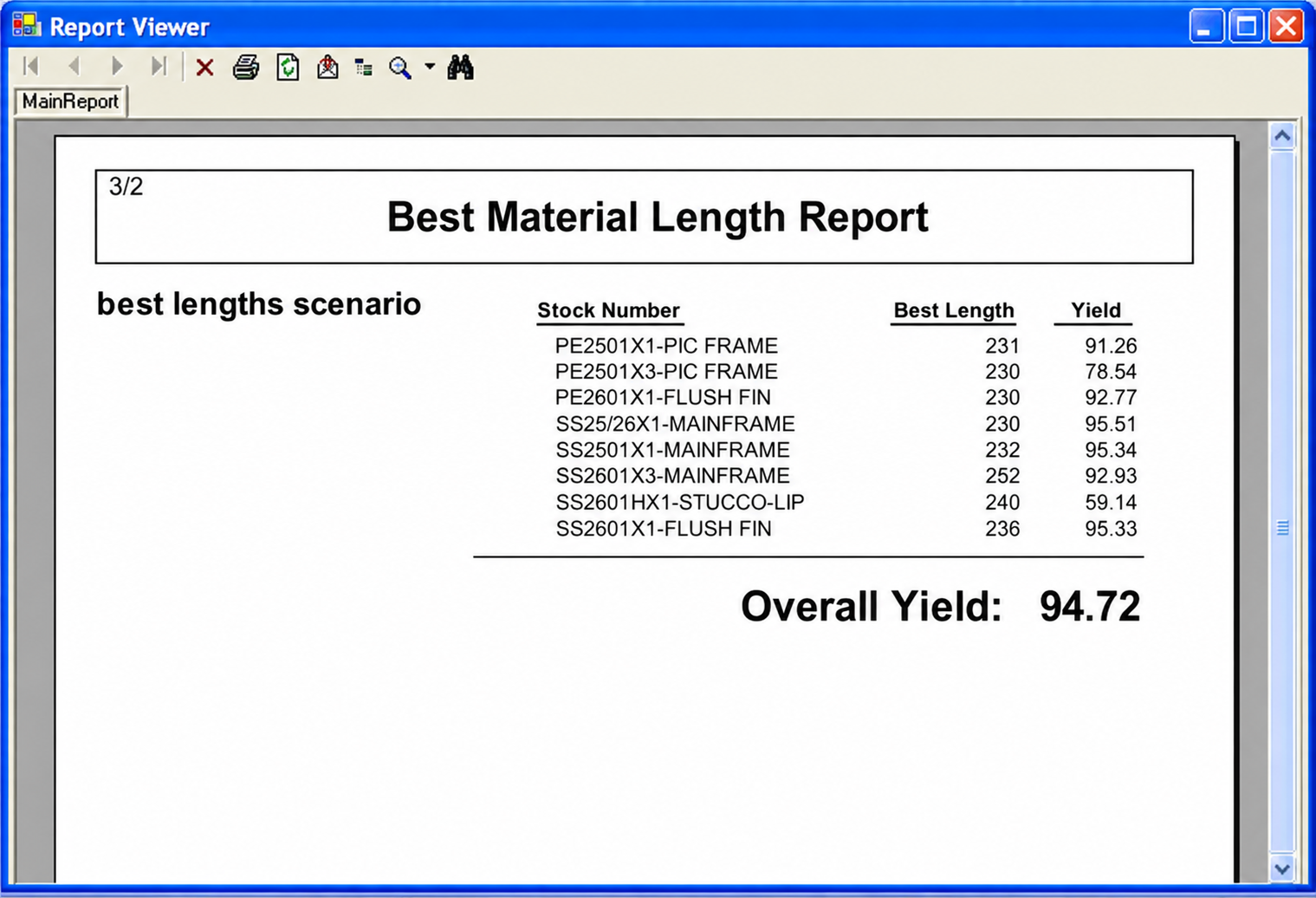
A material optimization report showing recommended material lengths, projected yield, and overall material utilization — helping manufacturers reduce scrap and get more usable product from every piece of material.
Material utilization is the most obvious example, but the same techniques can be applied anywhere there are many possible choices, competing constraints, and a clear definition of what “better” means.
That can include scheduling, routing, machine utilization, inventory allocation, or other operational decisions where manual methods struggle to evaluate all the possibilities.
For one manufacturer, Tornado’s material optimization software reduced material waste enough for the client to recover the full cost of the project in less than six months. After that, the savings continued.
These are the kinds of optimization problems Tornado has worked on—not generic off-the-shelf examples.
Optimizing how stock material is cut to improve yield and reduce waste across repeated production runs.
Arranging parts on flat stock while accounting for material size, spacing, orientation, and production constraints.
Optimizing sequence and machine movement to improve throughput in addition to material utilization.
Tornado also works with production scheduling, inventory, ERP and MES integration, HMIs, shop-floor applications, barcoding, reporting, machine data, and legacy manufacturing systems.
If scrap, nesting, cut planning, remnant usage, sequencing, or machine travel is costing more than it should, we can help determine whether custom optimization software could produce a meaningful return.